Unless your diet consists soley of termites, you've encountered sushi. While more Americans are ignoring the raw fish stigma and dining on this Japanese treat, how much of it is authentic?
If you would like a taste of what a sushi restaurant truly offers in Japan then look further than "Kantaro and the 100 Plates", a comprehensive blog detailing one American's journey of sampling every dish on the menu. The location of the expedition is none other than Kantaro, a conveyer belt sushi restaurant, in Aomori, Japan. While conveyer belt sushi restaurants can sometimes offer lower-quality, machine made sushi, Kantaro is at the high end of the spectrum offering a variety of properly prepared dishes.
'100 Plates' not only describes each dish in English but also provides photos, prices, and ratings. Hungry for sushi? Then study up by feasting your eyes on Tesia Smith's personal 'made in Japan' feeding frenzy.
Showing posts with label American Holidays in Japan. Show all posts
Showing posts with label American Holidays in Japan. Show all posts
Thursday, June 9, 2011


Extinct: Aomori's Fallen Amusement Park
It's hard to believe rural, snow-crippled 青森/Aomori played host to an amusement park. Though for over two decades, 浅虫ワンダーランド/Asamushi Wonderland thrilled locals over-looking scenic Mutsu Bay. In 2005, the park closed its gates, and now only a menegarie of abandoned infrastructure remains. For more on Asamushi Wonderland click here.
 |
| Abandoned Amusement |
Wednesday, June 8, 2011
The Wooden Fish
You haven't eaten Japanese cuisine until you've swallowed 'dancing fish flakes.' If you're not aware of what I'm referring too check out this video.
Thankfully these yummy fish flakes are everywhere! You'll find them quivering on top of okonomiyaki, takoyaki, soba and they're even known to hang out in bento (lunch boxes).
I was aware that they were tuna shavings, but really hadn't thought about how they ended up on my plate. One day while under the tutelage of Ukei Sensei, my well-respected pottery teacher and Japanese culture guru, I found out the truth!
These 'fish-flakes' known as 鰹節 (katsuobushi) or ぼにと(bonito) are wooden...or made from what looks to be a block of wood. Either that or a mummified fish carcus.
You could literally beat someone to death with this 'fish' and then shave off some pieces to devour your victim. I have a feeling katsuobushi is popular among angry cannibals.
A hunk of this stuff doesn't come cheap and sells for well over 1000円 ($12), though if shaven finely enough it will yield you plenty of fish flakes to last your tummy well into obesity. While anyone can shave at home, it's often left to the cooks, while the 'woodifying' process is best left to the professionals.
So how does a tuna fish become a deadly yet tastey block of wood? Instead of copying and pasting, I'll just now direct you over to wikipedia.
Happy wood eating everyone!
Thankfully these yummy fish flakes are everywhere! You'll find them quivering on top of okonomiyaki, takoyaki, soba and they're even known to hang out in bento (lunch boxes).
I was aware that they were tuna shavings, but really hadn't thought about how they ended up on my plate. One day while under the tutelage of Ukei Sensei, my well-respected pottery teacher and Japanese culture guru, I found out the truth!
These 'fish-flakes' known as 鰹節 (katsuobushi) or ぼにと(bonito) are wooden...or made from what looks to be a block of wood. Either that or a mummified fish carcus.
 |
| A man and his wooden fish. |
 |
| Hungry? |
A hunk of this stuff doesn't come cheap and sells for well over 1000円 ($12), though if shaven finely enough it will yield you plenty of fish flakes to last your tummy well into obesity. While anyone can shave at home, it's often left to the cooks, while the 'woodifying' process is best left to the professionals.
So how does a tuna fish become a deadly yet tastey block of wood? Instead of copying and pasting, I'll just now direct you over to wikipedia.
Happy wood eating everyone!
Monday, March 21, 2011
An Unlikely Drinking Partner: Graduation Parties in Japan
Sitting at a table with colleagues, a mature woman hiding her age with golden jewelry and charcoal stockings approaches saying, “Let me pour you a drink.” Standing up, she fills your glass with Kirin beer. A few minutes of regulated chitchat and she walks off to find another man. Before you can sit back down to grab your allotted piece of salmon, another woman arrives. She rakes her hair with wrinkled fingers before carefully pouring from a giant bottle into your nearly full glass. She keeps the chatter brief bowing 5 1/2 times. You exchange the mannerly physicality realizing the salmon will have to wait. Three more women and a gray haired man have formed a line.
Are you a celebrity? I’m afraid not. Are you a prominent bachelor irresistible to not only cougars but also the same sex? Perhaps, but not in the case. You are a 先生/teacher, specifically at a top academic 高校/high school. You are attending the 卒業式宴会/Graduation Party hosted by the Parent Teachers Association.
Each year, on the evening after graduation your attendance is required at the city’s finest hotel banquet hall. Fortunately, you don’t have to pay, because you already did. Mandatory monthly ‘party fund’ dues cover the evening’s expenses. Though, parents of the graduates each paid 5000円($60) to get you drunk.
For the teachers who have guided the students for the entirety of their 3 years in high school, the night is primed for celebration. The Japanese love a good drinking party with co-workers. Yet these affairs are exclusive engagements where ‘plus ones’ are outlawed. Consequently irony flows over the rim, when protective parents are watching every move and listening to each word as you, while intoxicated, attempt to remain professional.
This party functions like most 沿海. Most guests arriving 20 minutes early, check in to receive their official name badge and program. Everyone waits patiently whisper in the corridor as they review the seating chart. At precisely 6:30pm, the doors swing open and everyone pretensiously “ahhhs” over the complimentary bouqet of flowers on their chair. The master of ceremonies, always a tall attractive mother, welcomes guests and introduces the speakers. It’s not an official party until you have key note speeches.
To escape the boredom, I set up my 携帯/cell phone’s timer and make bets with those next to me on how long each speech will run. Luckily for us, the 校長先生/Principal, and members of the alumni association all average 6 minutes. Might I add, not a single drop of liquor is consumed until the official かんぱい/toast, another elongated minute speech, is delivered on stage. Everyone lifts up their plastic shot glass and downs their miniscule drop of 日本酒/sake. In past years, drinkers number 95%, though this year it seems as many are opting to skip over the drinking and just get the formalities out of the way.
Rounds of food are placed on the rotating chinese top on each table. Often, each dish has been divided into exactly the right number of pieces for each person. Though, luckily none of the food needs to be warm, so guests can mind the interruption of pouring parents. As bottles are emptied, servers quietly replace them. Though the only liquids available are Kirin Beer and unsweetened tea. Though, strangely at one point a mother approaches with a tray of whiskey and 諸チュ/shochu, a Japanese distilled liquor.
After a half an hour of mingling, a slide-show of pictures and videos from the past year appears on a gigantic screen, but with so much alcohol having been consumed, this gets ignored. The party continues until the last half and hour, when the entire congregation sings the school song, an old man serves as a cheerleader beckoning the audience to scream and clap their hands, and finally a flower ceremony for the homeroom teachers of the graduating students.
Before you can dash out, you have to bow to a row of parents who have assembled in front and out of the door to respectfully see you on your journey. Most teachers will secretly meet up with their friends and commence with the “real” party at a local snack bar or izakiya.
“I don’t understand why the parents don’t want to be with their children,” remarks a co-worker. This is often the case in America, where families will gather at a fancy restaurant to celebrate graduation. In America, actual parties occur over the summer and are an excuse to receive monetary gifts and drink for the first time with friends and family. There may be a party, but it would be exclusive for teachers and their plus-ones, often hosted by the local ring or gown supplier as a means to “stay in business.” American teachers are often placed in the same situation as the Japanese when they are invited to graduation parties. Though these, in many cases, will feature a student’s entire family, all of their friends, with most of them drinking. This is why most teachers kindly refrain from attending, though some option only if they use “safety in numbers” and arrive with several colleagues. The Japanese teacher doesn’t have that luxury, but at least it’s not in front of students, and it’s the parents who are pouring their drinks.
“I do not like this party,” said a co-worker. While this is not a complaint against parents, it’s simply an argument against the unusual circumstance of the occasion. Those unfamiliar with Japanese culture, should realize that alcohol is not seen as taboo. Teachers freely discuss their favorite drinks with students and openly comment on how “hungover” they are with co-workers. At anytime after 5pm, you can see a parade of drunken well-tailored men, and on the weekends it’s not unlikely to see an 80 year old drunkily collapse on the sidewalk.
It’s also one of the rare cases of “popularity.” While some teachers act as quarterbacks amidst a huddle of listeners, others catch up on their sleep dozing off at their table. This graduation party is clearly evidence of what teachers contribute the most to their students. Though, just like America, those who coach sports receive the most attention. However, parents also seem to adore those notorious for dishing out “tuff love.” Clearly, some teachers enjoy the chance to boast or receive their fair share of overdue ‘butt-kissing.’ The problem lies in how the teachers want to “party,” but have to remain “on the clock” until they can start the unofficial, parent-free 二期会 second party.
This form of graduation party is a Japanese tradition. Though due to its unsettling formalities, the custom is changing. While 青森高校/Aomori High School continues the tradition, attendance from parents has dwindled over the years. 青森南高校/Aomori South High School abandoned the custom in 20___. While, 富山高校/Toyama High School has found a solution by hosting an alcohol-free parent, teacher and student gala in the gym. Afterwars is when the teachers gather together to drunkilly wash away their hard work and guidance.
If you fancy older women, but are too shy to approach them, my advice is to become a high school in Japan. For only once a year, do parents and teacher gather to celebrate student success over glass bottles of liquor.
Are you a celebrity? I’m afraid not. Are you a prominent bachelor irresistible to not only cougars but also the same sex? Perhaps, but not in the case. You are a 先生/teacher, specifically at a top academic 高校/high school. You are attending the 卒業式宴会/Graduation Party hosted by the Parent Teachers Association.
Each year, on the evening after graduation your attendance is required at the city’s finest hotel banquet hall. Fortunately, you don’t have to pay, because you already did. Mandatory monthly ‘party fund’ dues cover the evening’s expenses. Though, parents of the graduates each paid 5000円($60) to get you drunk.
 |
| Let the Fun Begin |
For the teachers who have guided the students for the entirety of their 3 years in high school, the night is primed for celebration. The Japanese love a good drinking party with co-workers. Yet these affairs are exclusive engagements where ‘plus ones’ are outlawed. Consequently irony flows over the rim, when protective parents are watching every move and listening to each word as you, while intoxicated, attempt to remain professional.
This party functions like most 沿海. Most guests arriving 20 minutes early, check in to receive their official name badge and program. Everyone waits patiently whisper in the corridor as they review the seating chart. At precisely 6:30pm, the doors swing open and everyone pretensiously “ahhhs” over the complimentary bouqet of flowers on their chair. The master of ceremonies, always a tall attractive mother, welcomes guests and introduces the speakers. It’s not an official party until you have key note speeches.
To escape the boredom, I set up my 携帯/cell phone’s timer and make bets with those next to me on how long each speech will run. Luckily for us, the 校長先生/Principal, and members of the alumni association all average 6 minutes. Might I add, not a single drop of liquor is consumed until the official かんぱい/toast, another elongated minute speech, is delivered on stage. Everyone lifts up their plastic shot glass and downs their miniscule drop of 日本酒/sake. In past years, drinkers number 95%, though this year it seems as many are opting to skip over the drinking and just get the formalities out of the way.
Rounds of food are placed on the rotating chinese top on each table. Often, each dish has been divided into exactly the right number of pieces for each person. Though, luckily none of the food needs to be warm, so guests can mind the interruption of pouring parents. As bottles are emptied, servers quietly replace them. Though the only liquids available are Kirin Beer and unsweetened tea. Though, strangely at one point a mother approaches with a tray of whiskey and 諸チュ/shochu, a Japanese distilled liquor.
After a half an hour of mingling, a slide-show of pictures and videos from the past year appears on a gigantic screen, but with so much alcohol having been consumed, this gets ignored. The party continues until the last half and hour, when the entire congregation sings the school song, an old man serves as a cheerleader beckoning the audience to scream and clap their hands, and finally a flower ceremony for the homeroom teachers of the graduating students.
Before you can dash out, you have to bow to a row of parents who have assembled in front and out of the door to respectfully see you on your journey. Most teachers will secretly meet up with their friends and commence with the “real” party at a local snack bar or izakiya.
“I don’t understand why the parents don’t want to be with their children,” remarks a co-worker. This is often the case in America, where families will gather at a fancy restaurant to celebrate graduation. In America, actual parties occur over the summer and are an excuse to receive monetary gifts and drink for the first time with friends and family. There may be a party, but it would be exclusive for teachers and their plus-ones, often hosted by the local ring or gown supplier as a means to “stay in business.” American teachers are often placed in the same situation as the Japanese when they are invited to graduation parties. Though these, in many cases, will feature a student’s entire family, all of their friends, with most of them drinking. This is why most teachers kindly refrain from attending, though some option only if they use “safety in numbers” and arrive with several colleagues. The Japanese teacher doesn’t have that luxury, but at least it’s not in front of students, and it’s the parents who are pouring their drinks.
“I do not like this party,” said a co-worker. While this is not a complaint against parents, it’s simply an argument against the unusual circumstance of the occasion. Those unfamiliar with Japanese culture, should realize that alcohol is not seen as taboo. Teachers freely discuss their favorite drinks with students and openly comment on how “hungover” they are with co-workers. At anytime after 5pm, you can see a parade of drunken well-tailored men, and on the weekends it’s not unlikely to see an 80 year old drunkily collapse on the sidewalk.
It’s also one of the rare cases of “popularity.” While some teachers act as quarterbacks amidst a huddle of listeners, others catch up on their sleep dozing off at their table. This graduation party is clearly evidence of what teachers contribute the most to their students. Though, just like America, those who coach sports receive the most attention. However, parents also seem to adore those notorious for dishing out “tuff love.” Clearly, some teachers enjoy the chance to boast or receive their fair share of overdue ‘butt-kissing.’ The problem lies in how the teachers want to “party,” but have to remain “on the clock” until they can start the unofficial, parent-free 二期会 second party.
This form of graduation party is a Japanese tradition. Though due to its unsettling formalities, the custom is changing. While 青森高校/Aomori High School continues the tradition, attendance from parents has dwindled over the years. 青森南高校/Aomori South High School abandoned the custom in 20___. While, 富山高校/Toyama High School has found a solution by hosting an alcohol-free parent, teacher and student gala in the gym. Afterwars is when the teachers gather together to drunkilly wash away their hard work and guidance.
If you fancy older women, but are too shy to approach them, my advice is to become a high school in Japan. For only once a year, do parents and teacher gather to celebrate student success over glass bottles of liquor.
 |
| Got Flowers? |
Friday, February 18, 2011
A Winter Walk
"All truly great thoughts are conceived by walking." - Friedrich Nietzsche
When a town drowns in snow, the likely response is to stay at home. While I agree in the power of heat, it's impossible to cage curiosity. So one day the time had come for a walk, a winter walk.
Location: 青森市 (Aomori City)
 |
| No one said it was going to be easy! |
 |
| Snow Leaves |
 |
| A pedestrian's eye view presents the obscure. |
 |
| Talk about dedication. I've heard of fair-weathered fans, but these are cold-weathered athletes. |
 |
| Commemorative Couple Shot |
Thursday, February 17, 2011
Edible Statistics: McDonaldland Japan
"McDonald's cannot flourish without McDonnell Douglas, the designer of the F-15." - Thomas Friedman

On July 20th, 1971, the first Japanese McDonald's opened in Tokyo. While that's 31 years after the first one opened in San Bernardino, Japan has quickly become 2nd ranking nation with the most McDonald's.
With an estimated 312,072,000 people, the United States accounts for 4.52% of the world's population. With an estimated 31,000 plus locations globally, America's 13,381 locations account for roughly 43% of the world's McDonald's. In total, the US has one McDonalds per every 23,322 citizens.
While Japan, with a population of 127,370,000, has 3,598 locations. While Japan accounts for only 1.85% of the world's population it has nearly 12% of the world's McDonald's with one per every 35,400 citizens. Even my city of residence 青森市 / Aomori, with an estimated population of 302,068, has 5 locations providing one McDonald's per every 60,413 people. But 青森市 is in the rural Tohoku region. Now factor in Japan's bustling metropolitan areas, and that's a lot of McDonald's to make up for the numbers.
What about the competition? Burger King left in 2001, returned in 2007 and now has a mere 37 locations. America's 3rd fast food burger chain, Wendy's, left Japan in early 2010. Mos Burger, founded just one year after McDonald's landed in Japan, is the nation's 2nd largest fast food chain with an estimated 1327 locations. Consequently, McDonald's has nearly 3 times as many locations as its closest competition.
Of course these numbers don't account for competition, population density, tourists, economic factors, or dietary differences. Surprisingly using statistics alone, you're more likely to find a McDonald's in Canada, than either the US or Japan with one location per every 2,454 people.
Also surprisingly is that South Korea which shares some of Japan's food culture has only 243 locations with one per every 199,592 people. Lotteria, though first founded in Japan in 1972, is Korea's number one fast food chain accounting for 45% of the market.
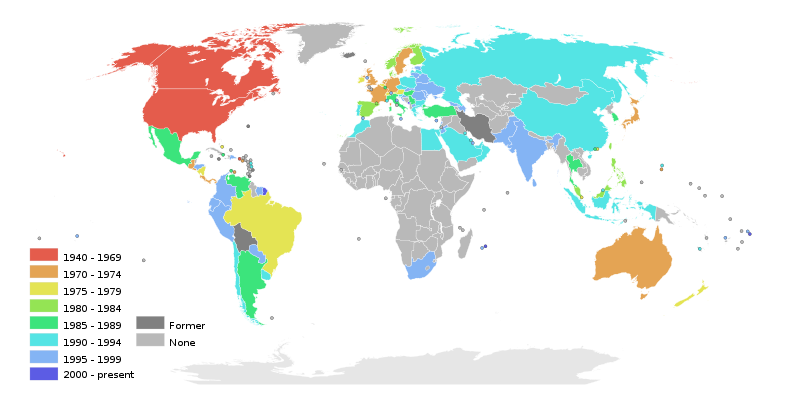 |
| McDonald's World Locations |
*Please note: Crave Cravak, nor craveVSworld claim no responsibility for the contents of this post nor attest to their validity. Please visit wikipedia for their respective world population and McDonald's pages.
Friday, January 7, 2011
Fat America: McDonald's Cooks Up Another Round of USA Burgers
Once again, America has invaded Japan. On January 7th, McDonald's rolled out its second wave of 'Big America' themed burgers. Those of you looking to fast track towards cardiac arrest while posing as a stereotypical American can look forward to four customized quarter pound beef patty sandwiches. The Texas2 is the first to debut with Idaho stampeding in late January, Miami swaying over in mid-February, and the Manhatten beeping its way through traffic in mid-March. Keep reading for individual reviews and in the meantime if you're fluent in Japanese head over to the McDonald's Japan official site. To recap the first round of 'Big America' please allow Steve Levenstein to cordially run down 2010's hearty burgers, or read the article in 日本語 (Japanese).
 |
| They're back! Say hello to the newest batch of juicy quater pound stereotypes! |
Friday, December 17, 2010
BOO! Halloween in 青森

The western tradition of ハロウィン (Halloween) is slowly creeping its way into Japanese culture. Currently Halloween is limited to pumpkin themed decorations and school sponsored costume activities for young children. The idea of Halloween as a sinful, guilt-free party seems to only occupy areas where foreigners reside in full force, such as Tokyo's Roppongi ward. 青森県 (Aomori prefecture) in Japan's rural north consequently lacks in 外国人 (foreigners). But that didn't stop a dozen english teachers from properly celebrating All Hallow's Eve.
Traditionally, a Halloween party is hosted by local charity Everest of Apples in the city of Hachinohe. This costume party is a popular event for the foreign population but usually lacks in natives. This year was different, and in 青森市 a public party was held at One-Shot Bar, a newly established 'western' bar owned by a former Tohoku Jet Ski champion.
It was delightful fun to see an equal mixture of stranges, local and foreign alike. Though, if there had been a costume contest, the Japanese would have came in dead last. Most Japanese just wear a hat or add an accessory. The ladies become a witch, and the men become Santa. Though, I don't think the lack of costume creativity has anything to do with the shy reserved nature of Japanese culture. While Party City would be a welcome addition, the Japanese are costume specialists. Most Karaoke parlors offer a selection of costumes to wear, women often transform into maids or school girls, and full body pajamas are made to look like Winnie the Pooh or Stich. In addition, it's hard to ignore cos players in Harajuku on Sunday.
If ex-pats continue to dress up children in costumes, and entice adults towards mischief, Japan will naturally adopt Halloween. I just hope trick-or-treating can eventually walk its way into the neighborhood.
Subscribe to:
Posts (Atom)


 Posts
Posts